Target Industry - Sustainability and Renewable Energy
Selection Criteria for Startups-
Focus: To aid in making India a leader in sustainable solutions which have low cost impact and have economies of scale. Trend: Renewable Energy, Sustainability Area of Interest: Renewable Energy, Energy Efficiency, Waste Management, Sustainable agriculture practices, Green Materials and Decarbonization.
Deal Flow
What are the things I need to know in order to build a good deal flow?
Who should I speak to for advice or support and how can I reach out to them?
What is the quickest version of this idea I can create this week?
Sustainability and Renewable Energy
Action Plan-
Understanding the technologies present in renewable energy and being implemented from Mr. Atul Rathod who works in “Suzlon Energy” and has worked in “JSW Energy”. Interview with Atul Rathod (GM Projects- Suzlon Energy)
Understanding where the electric industry is heading from Mr. Shikhar Srivastava who is heading strategy at “Sun Mobility Solutions”.
Connect with early-stage startups-their founders, access content generated by them-their blogs, videos to get idea about what more can be done. Start communication with them over email and LinkedIn to get to know them.
Attend startup events and demo days held by major VC Firms in cities of Bangalore, Hyderabad as these are the major cities where a lot of startups are taking roots. I will be attending eChai Ventures Founders Meetup where you can connect with new teams.
Research all major stakeholders of the startup ecosystem in the selected sector- Check portfolios of all major VC Firms and the startups they have funded in this space.
For the above startups- research the space they operate it, what problem they intend to solve, then search for similar startups who are competing for this space. This information can be easily found on LinkedIn, VC Circle and Crunchbase. The startup India website and National Startup Awards give good information across each sector.
Create a database of all the startups, founders in this space, keep reaching out to them as and when any player enters their space, any new technology gets introduced or new regulations are mandated.
As I am not from the ESG field, my expertise will lie in researching the trends, interacting with users of the ecosystem too. For this I will have to make a compelling pitch explaining my interest and knowledge to investors and startups.
Understanding the Market
Market Size
- What is the market size?
- Is it an upward growing market?
- What is the Total Addressable Market?
- What is the growth rate for the market?
Customer Analysis
- Who are the main customers in this market?
- What are their demographics, motivations, and behaviors?
Market Outlook
- What is required to enter the market?
- What are the forecasts of your market? Is it growing, contracting, changing? How?
- What has historically happened in your market?
- What is changing in your market?
Trend Analysis
- Based on your market, list 3-5 key trends in the last few years.
- Briefly summarize 5-10 highlights on deal activity in the past two years in the sector you have chosen.
Key Players
- Who are the key players in your space?
- What are the size of these companies? (Look at metrics like valuation, headcount, and market share.)
- What are their core products and services? Where does their primary revenue coming from?
- Where does their primary revenue coming from?
- How is their company is growing? (Look for metrics such as sales revenue, net profit margin, cost of customer acquisition (CAC), net promoter score (NPS), etc.)
Market Size-
The Indian sustainability market can be divided into the environmental tech and renewable energy market. The environmental tech market is around 23 Billion USD at start of 2024. It is expected to grow at a CAGR of 7.5% from 2023 to 2028.
In case of renewable energy the entire energy consumption of India can be considered as a market which is ripe for innovation. India had the highest electricity consumption of 250 GW in May of 2024. Currently the installed capacity in India stands at around 445 GW. The share of renewable energy in that was as below-
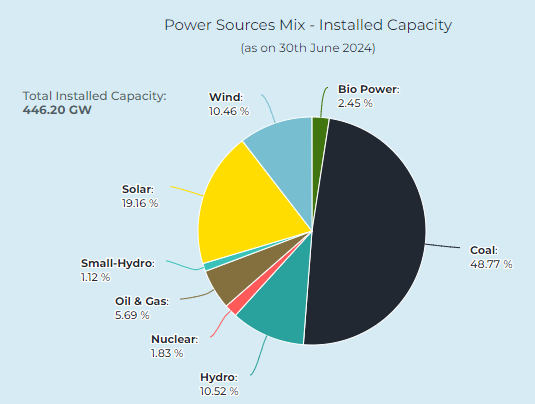
Source: Niti Aayog Portal (Govt. of India)
The year on year growth rate for the industry was 6.6%. With India’s increasing population and development the energy requirement is only going to increase.
In case of Climate Tech Circular Economy is also garnering a lot of attention with e-waste alone accounting for nearly 16 Lakh tons from all over India out of which only 31.25% was collected and recycled.
The case for Circular Economy in India →
Year E-waste Estimated Generation (in Tons) Total Quantity of E-Waste Collected, Dismantled & Recycled 2017-2018 708445 69414 2018-2019 771215 164663 2019-2020 1014961.2 224041 2020-2021 1346496.31 354291.22 2021-2022 1601155.36 527131.57
Customer Behavior (Motivations, Inhibitions)-
Types of Customers in the market-
- Active consumers who will seek out green products and choices over convenience and economics.
- Convenience consumers who will only use green products when it is convenient for them.
- Passive consumers who do not seek green products but will buy if made aware and offered at the same price as normal products.
- And last are the consumers who do not care whether their choices affect the environment.
The customer wants to go towards sustainable solutions but has the following inhibitions on large scale adoption-
- Economics - Sustainable products are still expensive than normal products, they are attracting a premium which is making it inaccessible for people with enough motivation to buy but not enough money to spend.
- Unclear impact - Customers do not have a clear idea of how much positive impact on the environment their usage will create. This leads to a fear of greenwashing.
Trend Analysis-
Deal Activity -
- The funding for environment/climate startups in Year 2022 was highest USD 5 billion and saw a 29% increase from 2019 but saw a dip in 2023 which was just USD 1.2 Billion.
- Out of total deal volume 667.9 Million USD or nearly 54.3% was in electric mobility only.
- The second runner up was clean energy at 390.3 million USD and 31% of the total.
- Agriculture, waste and water still need a lot of attention as they drew miniscule funding.
- India still trails the USA, China and even smaller nations in Europe in Climate Tech/Environment Tech funding.
- While Indian startups drew 5 billion USD, startups in US raised about 28.6 billion USD and China raised 10.6 billion USD.
- At global level unlike India the top draw of capital is Clean energy tech followed by E-mobility.
The Biggest deals of the year were as follows-
- Ola Electric - Raised $385 Million in e-mobility sector.
- Cleanmax solar- Raised $360 million in renewable energy sector.
- Blue Planet- Raised $35 million in waste management and upcycling.
- Battery Smart - Raised $55 million in e-mobility sector.
Key Players-
- Electric Mobility -
The key players in this sector as are follows-
- Ola Electric - It is an manufacturer of electric 2-wheelers- The total funding it has received is in tune of 1 Billion USD. Its’s latest post money valuation is 5.49 Billion USD. Its’s annual revenue is 347 Million USD. In the electric 2-wheeler manufacturing market, it has a market share of nearly 26% second to Ather energy which has 30%.
- Blu Smart- It is an EV cab aggregator with presence in 2 cities of Delhi/Gurgaon and Bengaluru in India. Unlike Ola and Uber which provided finance to existing cab drivers to drive electric vehicles, Blu Smart maintains its own fleet and drivers. This has given them the benefit of keeping their cost of charging the vehicle low as they do not have to depend on charging stations which still charge a premium. The latest valuation of this company is 234 million USD. The revenue of this company is 8.84 Million USD. Blu smart has a market share of nearly 51%.
- Renewable Energy Tech -
The key players in this sector are as follows-
- Waree Energies leads the pack with a revenue of nearly 828 Million USD. It manufactures PV panels for solar power generation. It has a 33% market share and other competitors include Renewsys World and even established corporates like Adani Solar.
- ReNew which generates and sells Solar power as an independent power generation company. It faces competition from corporates like Adani Renewable Energy, JSW Energy which are acquiring and consolidating assets for power generation in both solar and wind.
- Adani Green Energy- It has annual revenue of 1.26 Billion USD and is a listed company in India.
In Hydrogen Production and Storage-
- Ossus Bio-renewables- This firm provides cell solution to produce hydrogen from wastewater. It has a annual revenue of New Trace which produces electrolyzers for green hydrogen generation and is in a seed stage. There is no competitor for Ossus in India at this movement.
- Circular Economy-
- Bambrew which makes bamboo based packaging which can be recycled and is biodegradebale.
- Phool which makes incense sticks, dhoop and others from flower waste generated in temples.
- Greenpod Labs-Which extends the life of perishable products like Fruits and vegetables- reduces wastage by ripening in transit.
Pitch Deck Analysis
Renkube
Link to pitch deck→ https://www.slideshare.net/slideshow/renkube/239472825
Website of the startup → https://www.renkube.com/
Introduction
The startup is in the business of manufacturing special glass mounted on a panel which re-directs sunlight at all times of the day on the panel below. This increases the power generated by the solar panel. The efficiency of PV panels is increased by the usage of this tech. The startup is based out of Bangalore in India and is founded by a group of 4 people all who hail from the company Cisco.
Market Size
- The entire solar panel market in India was 10.4 billion USD in 2023.
- The CAGR for solar panels in India from 2024 to 2030 is 13.4% and it is an expanding market as the government provides impetus to renewable energy and the entry of big corporate players like Adani Green Energy in the market.
- It will reach 24.6 Billion USD till 2030.
- India’s current solar power generation capacity is 79 GW and will increase to 195 GW in the upcoming years.
- Competition- It has no active competitor in India as of now which use similar technology which is Motion Free Optical Tracker.
- It’s competitors in the world are “Nextracker” which is a US-based solar tracking solution provider company and has a large established revenue of USD 1.46 Billion (FY21-22).
- The market timing is right for the company as cost of the panel manufacturing is coming down which will make it more lucrative. India as a country has large parts which receive sunlight throughout the year. The hindrance for growth will come from factors like distribution losses, storage losses and large CAPEX involved in these projects.
Product and Problem
- The long standing problem with solar power has been the inability of the panels to capture the entire available sunlight as the sun moves from east to west. This reduces the total power generation and the efficiency of the solar panel.
- While companies tried to fix this by making mechanical solutions which move the panel from one direction to another as the sun moves, there was lot of headache in maintaining the moving parts like the gears.
- Renkube has tried to fix this by inventing a motion less optical tracker which is part of the glass mounted on the panel.
- While the cost of this panel can be higher from the conventional panels by 5%, the energy gain can be as high as 20% in certain parts of India.
- This solves a long standing problem of the solar panels. As there is no movement, there is no wear and tear or any maintenance required. This increased the life of the panel too.
- But this cannot be retrofitted on existing solar panels and entirely new ones will have to be bought. This negates the chances of the startup capturing the existing solar power parks.
- The product is still in testing stage at an agricultural university in Telangana.
- The company is proposing this product can be used as an Agri-PV setup with solar panels being installed above existing crops and then the remaining sunlight from the panels can be reflected towards the crops too.
Team
- The team consists of Balaji who has done engineering in EEE from Coimbatore and was a principal scientist at Cisco before moving as a founder at Renkube. He has worked extensively on networking devices while at Cisco and has 13 patents which shows his hunger for exploring new horizons.
- Together with Balaji we have Lakshmi Santhanam who has a PhD in Compute Science from University of Cincinnati and has written publications with him on the same subject field of Motion Free Optical Tracker, Thermal Modelling of Renkube Panel and Yield of Rabi Crops under Agro-Photo Voltaic Cell.
- Third co-founder is Deepika Goyal who has done her MSc. in Computer Science from UC San Diego. She also has been a part of Cisco.
- Janardhana V. is the co-founder who has actual experience in manufacturing and will be key in deploying the product.
- The team is heavy on computer science and networking side while the startup is based on renewable energy, PV panels and optics. This might create a hindrance when cost and economies of scale become important. As per their use case of Agri-PV too there is no one who has experience in terms of agricultural sciences. But the research papers published on above topics shows their willingness to learn the basics before moving to implementation.
Metrics
- The revenue of the startup is Rs. 15 Lakhs in the last financial year.
- They have received an investment of 2.4 Crore Rupees till now in funding. As per their website usage statistics as compared to other PV manufacturers they have around 22% of the traffic which is indicative of the interest the market has in their potential.
Ecostp
Link to pitch deck → https://www.slideshare.net/slideshow/ecostp-presentation/239640833
Website of the startup → https://www.ecostp.com/
Introduction
Ecostp is a seed stage startup with focus on building small de-centralized sewage treatment plants to treat waste water from sewage into fresh water which can be re-used. The startup has implemented this model successfully for apartments and industrial complexes. The startup claims the STP is a zero chemical, zero energy consumption unit.
Market Size
- The Indian wastewater treatment market was valued at USD 1.51 billion in 2023.
- The market is set to grow at CAGR of around 11.22% as population in India rises and more and more Indians move towards the city in search of a better life.
- In the short term there are around 55 pending STP projects in India in tune of Rs. 151 Billion which are proposed.
- India only treats 28% of the waste water generated which means there is a large supply demand gap which can be bridged by the startup.
Product & the Problem
- India generates around 72,368 million liters per day of sewage out of which only 28% gets treated and the remaining is left to flow into ponds, lakes, rivers and even sea.
- This creates problems of wildlife destruction, water pollution, spread of hyacinth on drinking water and even odor for people living nearby.
- In a country with increasing population, water is a key resource even non-potable water. As population increases water tables are running dry as more and more water is pumped out.
- The product will recycle the waste water which can be used for watering the plants, recharging the ground water table and for non-potable purposed in urban societies.
- The product proposes a product which is like stomach of a cow with multiple chambers. This is called bio-mimicry. Use of anaerobic bacteria ensures that waste water is completely converted into good water.
- It has no moving parts and does not require any pumps or motors.
- As it does not have any odor it can be installed in underground premises too below parking areas, shades and other non-usable spaces.
- The product costs around 5 to 10 lakhs without the civil work and has an expected ROI of around 2 years only.
Team
- Tharun Kumar- He has executive education from IIM Bangalore and has worked in tech companies Motorola, Sutherland Global services before pursuing a stint in Paradigm Environmental Strategies which researches and develops technologies in solid waste management, waste water treatment. This enabled him to take advantage of this knowledge in ecostp.
- Lokesh Rajashekaraiah- He has a rich experience in lean six sigma implementation and as head of transformation in AbinBev he has speared execution of large initiatives. Although he has no experience in waste water management.
- Ramya Rajagopal- She as a co-founder has experience in content delivery and in training programs. No prior experience in waste water treatment.
Metrics
- The revenue is 2.6 Cr Rupees for period ending March but the startup has yet to become profitable.
- It has 64 small and medium projects under its belt.
- Its post money valuation is 1.85 Million USD and is still far from creating any dent in the market as cities have large projects and the company has been focused on small projects with companies.
Canvaloop
Link to Pitch Deck → https://pitch.com/presentations/Canvaloop-Pitch-Deck-0BQmet3vwkh35Ekvep79WW9m
Website of the startup → https://www.canvaloop.com/
Introduction
Canvaloop focuses on converting agricultural waste into textile fibers which can be used for manufacturing fabric. It has changed the entire value chain of textile industry. They claim to use 99% water less than that required for cotton and 88% reduction in GHG emissions. They provide visibility across
Market Size
- India is the 2nd largest consumer of cotton in the world.
- The consumption of cotton in FY 23 was in the tune of 5.29 Million Metric tons which is around 23% of total cotton used in a year.
- If you take the market for other type of fibers the market potential is huge. The market for cotton is pegged to grow at 2.96% CAGR till 2028.
- As advent of fast fashion like Zara takes over, the turnover of clothes has increased. Additionally the focus towards wearing sustainable clothing has increased in the recent years and brands are on the lookout for the same.
Product & the Problem
- 10k liters of water are used just to manufacture one pair of clothes through the complete value chain.
- Repeated washes also releases micro-plastics in water bodies. Polyester cloths dumped would not dis-integrate and cause further problems.
- Canvaloop proposes converting agro-waste of bast crops into textile fibers which uses less than 10 liters of water per kg. This reduces air pollution too as farmers burn this waste.
- The startup promises that the fiber is 40% cheaper than normal fibers.
- Existing companies can use the fibers without any modification in their equipment and process which will increase their adaptability.
Team
- Shreyans Kokra- Has good experience working in companies in the textile industry like Ambaji Dyeing, Vishal prints and has a certificate in textile technology from ATIRA in India. He is also a foruth generation entrpreneur in textile. This gives him the edge in depth of knowledge, contacts and even pitfalls of the sector.
Metrics
- 1800 tons of Fabric manufactured by the startup in Q1 2024.
- Its revenue at the end of FY 2023 was 3.1 Cr. It has been sourced by major fashion labels like Arvind Fashions, Lewis and even Adidas.
Pitch Deck Evaluation
Renkube- The pitch deck does not give any clear idea about the product. The deck claims to have a proprietary software but does not give any indication what it will do. It does not give a roadmap as to how the startup will scale from this stage onwards. Good point is it is clearly able to articulate the savings by using the product. The added studies of gain in locations world over gives it the ability to scale to global level. Unit economics data is not clear about how costly it is above normal panels.
Ecostp- The deck articulates the problem effectively and gives proper idea of the solution in practice. It also shows the clients they have targeted and successfully converted. Benefits are called out perfectly in a concise manner. The deck fails to explain how the product works or how it is constructed. It does not give any roadmap for future expansion or how it plans to use the funds to use. The market opportunity is not called out properly.
Canvaloop- The deck is properly made as it articulates the problem, the market opportunity and the roadmap perfectly. The founder has mentioned clear use of funds invested. The explanation of the process of conversion is less though in the deck. Its strong points over its competitors are also called out well.
Final Recommendation
Among these 3 startups, Canvaloop stands out as the startup with the most potential because of the following points-
- Roadmap is properly defined with the target ambition.
- Road to profitability is mentioned well.
- While others have no clear revenue stream and are still in pilot stage this startup has already started production and supply of goods.
- The product can be utilized with no additional CAPEX at the customer’s end which is a clear differentiator from Renkube which cannot be retro-fitted and Ecostp which requires a complete new setup.
Notes on Startup Analysis
Understanding the Market & Customer →
Includes assessing the markets current and future potential - size, growth rate, trends and competitive landscape. VCs look in the market as the company does not have long history of financial track record.
Look at-
- What is required to enter the market? Entry barriers.
- How much chance the startup has to make a dent in the market?
- What is their differentiation from the existing companies in the sector?
- Is the market they are targeting a dead market or a transition to a different trend? (upward market. room for growth)
TAM - Total Addressable Market (avg. annual revenue from all customers available in the market) →
SAM- Serviceable Addressable Market (Portion of market company can acquire based on their business model- target)
SOM - Serviceable Obtainable Market (Portion of market share that can be realistically be obtained by the market)
We can learn about the customers by asking the right questions like - their demographics, income level, location and motivations.
Market Outlook →
Market outlook answers whether the market is growing or contracting?
What has historically occurred in the market?
What is changing in the market?
How to find trends and deal activity in the target market?
- What has been big in the industry news?
- Did any regulation occur which has impacted your industry?
- What are industry leaders/influencers doing?
- What has seen a lot of new customers and has blown up?
- What major changes will be in your industry? Looking at regulation, key player movement, emerging technology.
- Look at money raised by startups and how much they have raised?
- Which companies failed and shut down?
- Listening to consumers if any trend is receding?
What to do after finding a trend?
A lot of a VC’s job is just about staying up-to-date with the cutting edge of new industries (hence, the importance of curiosity and love of learning!), which will allow you to have the specialty to identify opportunities.
Once you have an industry you feel is trending, talk to people in the space 🗣️, develop relationships 🫂, and constantly read 📚, listen 🎧, and watch 👀, while following and looking at the industry trends in more depth.
Some VCs make use of and monitor trend charts, also known as run charts, which show trends in data over time for certain industries.
Sizing up the competition →
Understanding who the competition is would help you identify whether a startup is truly unique, and if they can win the market.
- Understanding the startup scale through traffic visits to their website, country wise breakdown, competitors and marketing channels.
- Understanding the product and Market - can check what ads a company is running on different platforms by use of Facebooks Ads, Google Ads. Keyword search -With this, you can see 2 things: how many people are searching for the company (indicating size) and what kind of search terms lead to website visits for the company. Both are interesting to understand.
- Product reviews give a fair idea of the product too.
What to look for in a startup →
- Over index on the founder before you move to the idea or the industry that the startup is working in.
- They should be ambitious- but the vision and scope of their idea should be really game changing. The idea should be such that the entire industry landscape should change.
- A plan or a map between this state and the end state like the person should know what action he wants to take to reach there. Should not struggle to get momentum just because the idea is big. Bias to action.
- Iterative approach- to try things out and then if it does not work move towards another solution. Somebody who can hold high degree of complexity and be calm.
- Humility around what they don’t know and then learning that, asking around. Was the founders background helpful in finding the solution. Is the problem big enough to have people rallying around it. Unit economics.
Pitch Decks →
Consist of the following elements-
- Company’s vision (Contains Backstory and Problem statement too)
- Value proposition
- Business Plan (Contains Timeline)
- Market Opportunity (Market Analysis - Barriers to entry)
- Growth Potential
Factors to Analyze a Pitch Deck-
Market -
- What is the market they are playing in?
- Does the team understand the market they are entering?
- What is the market size?
- Who are the key players?
- How well-positioned is the startup to enter and succeed in this market?
- Are there significant barriers to entry into this market?
- What are the trends in this market?